New exhibitionAra Zamanın Kıyısında (On the Shore of In-Between Time) · Caddebostan Cultural Centre, İstanbul · 9 November – 1 December 2026
Painter · Academic
M. ZahitBüyükişliyen
“Being an artist is not a profession. Nor is it merely a matter of execution; it is an originality brought forth with one’s soul, one’s mind and one’s stance.”
M. Zahit Büyükişliyen
Works
M. Zahit Büyükişliyen
Periods
An artistic journey of nearly sixty years
Writings
By the artist and about him
My View of Art: Déjà Vu
The intellectual system of the original bonds I have formed with abstract forms of expression – bonds that have enriched my understanding of art and made it personal – intersects, I believe, with life itself. What is life? What is the meaning of life? When is this question asked, and at what moments? Is it when we realise that there is an “I” beneath our outward appearance and begin to question the world in its relationship to us? When we feel cornered, trapped, or on the verge of a radical decision? When we no longer hear the echo of our own voice? When, at an unexpected moment, we find ourselves face to face with death?
If life is a becoming that ceaselessly unravels and gathers itself again, one that can never be grasped a second time, we fear finding no meaning in it. We feel the need to create a separate meaning for every single life. In our past lie the intricate traces, the chance events and the people that made us who we are. Memories are slippery; they keep escaping our grasp…
One can grasp even one’s own life only by looking at it from the outside, not from within, and so… We suffer; there are times when we wish life would treat us more gently, more fairly. We long for success, for peace, for being loved and for feeling secure. Yet whatever happens, our story becomes a true story only after it has been lived.
It is our soul, our passions and our longings that truly give colour and form to our adventure. Our past is made visible by the light that falls on what we have actually brought into being. And the meaning or meaninglessness of a life derives from the outcome that life arrives at, the place it finally reaches.
M. Zahit Büyükişliyen
Don Quixote, a Hero of Dreams
Goslar is a town in Germany. Wandering through Goslar’s narrow streets among buildings that have survived from the Middle Ages, you come across a contemporary museum: the Mönchehaus Museum, a place that holds the memory of modern and contemporary art… In the museum’s garden stands the “Don Quixote House”, an old building from the Middle Ages… Inside, it is filled with Don Quixote books, paintings and sculptures – works on the theme of Don Quixote by Pablo Picasso, William Hogarth, Daniel Chodowiecki, Gustave Doré, Salvador Dalí, A. Paul Weber, Le Corbusier and many other famous artists.
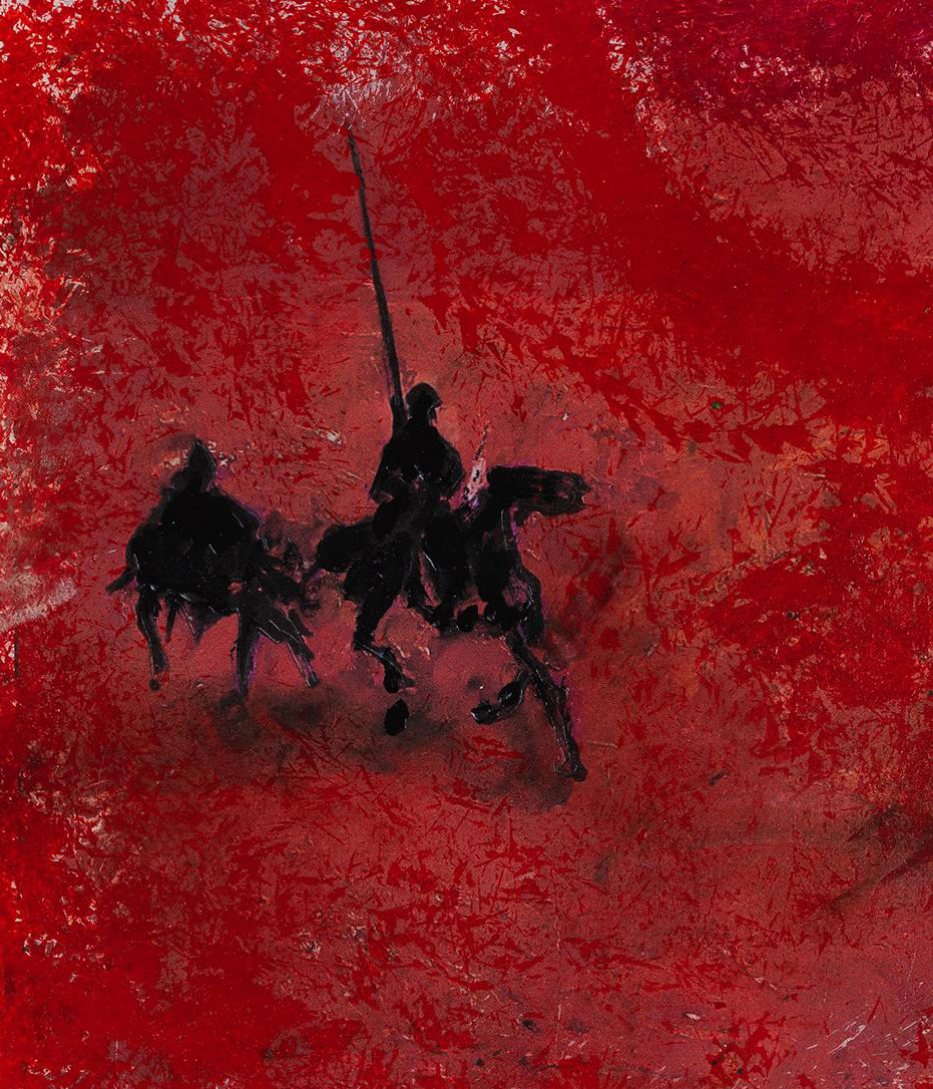
In 2016 the curator İbrahim Karaoğlu, together with Bettina Ruhrberg and coordinated by Meryem Schultz, exhibited this collection at the Çankaya Municipality Contemporary Arts Centre in Ankara. A selection of contemporary Turkish painters was added to the collection of more than 100 works. When I was invited to take part in this exhibition, I took my first step into the Don Quixote concept. Feeling a deep affinity with Cervantes’ hero, I began to create Don Quixotes of my own. (The painting I made for that exhibition is now in the museum in Germany.)
What stands out in Don Quixote is a rich and creative imagination, the meaning of an endlessly humorous life, and a profound grasp of the structure of reality. The expression “You’re tilting at windmills!” has gained meaning all over the world. He has become a hero of dreams interpreted by many painters.
This character, the subject of so many painters from Daumier to Picasso, became bound up with me too, for a long time… That is how my Don Quixote paintings came about…
M. Zahit Büyükişliyen
“I Looked upon You from a Hill Yesterday, Dear İstanbul…”
Some, born lucky, were born in İstanbul, went to school in İstanbul, lived and grew up there. Others came later, because its very stones and soil were said to be gold – to work, to toil, to make a living.
I first saw İstanbul at the age of seven, arriving on a steam train from İskenderun, the Taurus Express… after a journey of three days and three nights… What has always stayed in my mind is the monumentality and magic of Haydarpaşa Station… boarding a snow-white ferry with smoke rising from its funnel… my brother, my mother, my father and I. Seagulls, and a misty, hazy İstanbul.
Our İstanbul adventure lasted two years. From the window of our third-floor flat in Laleli I watched children sledging in the snow and people slipping and falling on the icy street… The year 1952 was very cold in İstanbul. My father was a man used to being his own boss. He could not forget beautiful İskenderun, that warm seaside town. We went back to İskenderun.
İstanbul remained in my dreams: Laleli, the cinemas of Şehzadebaşı showing four films at a time, Sarayburnu, the shores of Yenikapı, and my school, Ragıp Paşa… After that I lived İstanbul only through films. I longed for the summer holidays, because in summer we would go to İstanbul.
Guided by my literature teacher, my passion for poetry and theatre began in my high-school years. There are so many interpretations of this City of İstanbul – from Nedim to Yahya Kemal, from Orhan Veli to Necip Fazıl, from Bedri Rahmi to Cahit Sıtkı, from Ziya Osman Saba to Özdemir Asaf, from Turgut Uyar to İlhan Berk…
Let these paintings be my interpretation of this City of İstanbul…
M. Zahit Büyükişliyen
Alexandretta (Little Alexandria)
My identity card gives my place of birth as Adana. But I was actually born in İskenderun. Because our family was registered in Adana, my identity card was issued there.
What a beautiful city İskenderun is. A glorious sea, a sandy beach, starfish, mussel shells, fishing nets, palm trees, boats along the shore and the glimmer of phosphorescence on the water. Everything smelled of orange blossom and jasmine, a scent that mingled with the smell of seaweed.
İskenderun was a city of tolerance and affection, a mosaic of cultures and religions. Alevis, Kurds, Turks, Syriacs, Arabs, Orthodox, Protestant and Catholic Christians and Jews lived side by side with affection and understanding, respecting one another’s cultures and beliefs.
At İskenderun High School we were taught by excellent teachers and made friends with wonderful people. We read, we argued, we played games. Theatre companies came to town and we went to see them. The cinemas were our favourite meeting places: there were twenty-five open-air cinemas and five indoor ones. Everyone rode bicycles, and there were horse-drawn carriages too…
I painted pictures interpreting the old İskenderun, the beautiful İskenderun in which I lived, and today’s İskenderun, disfigured by unplanned growth and concrete.
M. Zahit Büyükişliyen
27 December 2022
Original Prints
My first encounter with original printmaking came during my years at the Gazi Institute of Education. In 1965, when I was still a second-year student and preoccupied with the relationships between form and patch of colour, and between line and surface, my very first attempt – a linocut – produced results that could serve as an impulse for my paintings. After linocuts and woodcuts I went on to etchings and screenprints.
During my first teaching post, at the İvriz Teacher Training School from 1967 to 1970, original printmaking became a technique that I both taught my students and pursued intensively in my own work… For one thing, it was very economical: a piece of plywood (the top and bottom of an oil crate) could be engraved with a penknife, a nail or a scrap of wire. Then, with a press improvised from the roller of a scrapped washing machine, ink could be applied to the “block”.
And then… abroad… Kassel, the city of documenta… An atmosphere I did not know. I wanted to start from scratch for my first works… I drew, I made studies… At the same time I concentrated on lithography, which had always intrigued me. Now I was working in every technique, and in an environment where nothing was impossible.
Working directly on stone, silk or a metal plate makes it possible to capture momentary bursts of feeling. In other words, the danger of knowing the outcome of the adventure from the outset disappears.
In conclusion, I believe that my original prints had an important influence on the formation of my own artistic language, and that the works I have been able to produce should be regarded as milestones in the journey from the beginning to the present day.
M. Zahit Büyükişliyen
Mehmet Zahit Büyükişliyen and His Abstract Landscapes
Büyükişliyen is known for paintings that may be described as “abstract landscapes”: surfaces that combine light and dark values, dense impasto and thin sprayed or dripped layers of paint, at times bearing calligraphic traces and occasionally enriched with collage and photographic transfer. Their subject matter is the set of issues that surround the individual: environmental pollution, the disappearance of natural life, the tension between nature and technology, unplanned urban growth and industrialisation.
For the artist, every painter must create the materials and techniques suited to his or her own nature. As a student at the Gazi Institute of Education he worked not only in painting but also on abstractions of figure, space and nature in linocut, lithography and intaglio; in 1965, at only nineteen, one of his works was accepted for the State Exhibition of Painting and Sculpture. The real turning point, however, was his appointment in 1967 to the İvriz Teacher Training School: his first encounter with the Central Anatolian steppe launched the landscape abstractions that would accompany him throughout his career. “Apple Orchard in İvriz” (1968), in which the marks of the palette knife give the first signs of fragmentation, is one of the early examples of this semi-abstract search.
At the Kassel State Academy of Fine Arts, which he entered in 1971 after passing a state examination, he studied under Prof. Kausch and Prof. Hillmann and mastered lithography, etching and screenprinting. The collage and montage he explored in printmaking during these years gave his painting a conceptual dimension; city silhouettes, architectural drawings and compositions with a sense of incompleteness came to the fore. In 1976 he graduated from the academy with a thesis on migration and the gecekondu and returned to the Gazi Institute of Education. “Semiotic signs” and colour scales now appear in his paintings: in the artist’s words, each square is a unit of a person, a time or an event, and placed side by side they narrate a process of change.
The Gazi period was when he began to gain recognition in the Turkish art world. The gulf between Germany and the turbulent Türkiye of the years before the coup of 12 September 1980, unplanned urban sprawl and Ankara’s deadly air pollution intensified the expressive force of his painting; yet the artist delivers no direct message, building his painting on an abstract plane and leaving it to the viewer’s intuition. On the occasion of his 1982 exhibition at Vakko, Adnan Turani wrote that he abstracted natural images by estranging them and was moving towards an “illumination of colour”. In 1988–89 he entered a new technical phase with photography, screenprinting and collage; high-chroma reds, intersecting square fields and references ranging from Chernobyl to Hiroshima give his paintings an unsettling atmosphere.
“Visual Notes after a Long Winter in Ankara” (1992), painted after the turbulent early 1990s, is dominated by black and white yet achieves a polychrome effect through carefully calculated warm and cool tones, and carries a deep melancholy. His move to İstanbul and to Yeditepe University in 1997 brought a new environment that is reflected in his painting: in a series of 1999 he constructs the relationship between earth and sky with vertical bands, deliberately leaving the sky empty. According to Kaya Özsezgin, these paintings open the way to a renewed approach to the concept of landscape at the level of contemporary aesthetics.
From 2006 onwards a new object enters his paintings: rows of coloured stones that cast their shadows into the pictorial space. In works such as “From the Abstract to Stones, from Stones to the Abstract” he turns to a sparer style; the sculptural, three-dimensional presence of the stone heightens the atmosphere of the abstract composition and offers an alternative to the tachiste approach. The article closes with the sentence the artist wrote in his diary for the “Aspat” paintings of 2008, which sums up his entire journey: to unite inhalation and exhalation on the horizon line; above, infinity and clarity; below, the intricate texture of being and non-being.
Assoc. Prof. İsmail Ateş
“Mehmet Zahit Büyükişliyen ve Soyut Peyzajları Üzerine Bir İnceleme” (A Study of Mehmet Zahit Büyükişliyen and His Abstract Landscapes), Anadolu University Sanat & Tasarım Dergisi (Journal of Art and Design), pp. 15–24. Summary of the article.
Space, Void and Nature – or the Nearness of What Lies beyond the Horizon
Looking at Zahit Büyükişliyen’s recent works, I was prompted by an association that could reach as far as John Locke’s “Essays on the Law of Nature” and Giorgio Agamben’s L’aperto (The Open). I encountered a pictorial language in which the human figure is not represented, yet human action reveals signs of its presence as a violation of a “law of nature”. “The sentence of condemnation that every man passes on himself when he has done wrong – proves that there is a law of nature,”1 says Locke. What we are speaking of here is a sensitivity of conscience with regard to nature. The notion of the human being as a creature that acts in accordance with nature takes us all the way back to the philosophical edifice of the Stoa. For human beings to act in accordance with nature also means acting in accordance with their own nature. To hold such a view means to acknowledge the existence of the animal within us as well. When the human being, as a creature that has distanced itself from nature, sets out to establish its presence in the place we call the world, it in fact brings about the slaying of the animal within; and this undoubtedly points to the source of the dominating attitude that humans impose in defiance of nature… Is it not precisely here that human beings ought to hold a sentence of condemnation, one that heeds the law of nature, against their own wickedness? It is traces of exactly this kind of awakening of conscience that we can find in Zahit Büyükişliyen’s paintings.
In L’aperto Giorgio Agamben focuses on the intimate strife between “world and earth” in works of art to which Heidegger drew attention: “In both, the same paradigm seems to enclose both openness and closedness. In the work of art too (in the opposition of world and earth), what is at stake is the dialectic between concealment and unconcealment, openness and closedness.”2 In this case the world, as the open, and the earth, as the announcement of what is closed, turn the dialectic of “concealment and unconcealment” into the ontological paradigm of truth. “The earth appears openly cleared as itself only when it is perceived and preserved as that which is by nature undisclosable, that which shrinks from every disclosure and constantly keeps itself closed up.” (The Origin of the Work of Art, Heidegger) In the work of art, this undisclosability comes to light as it is. “The work moves the earth itself into the open region of a world and keeps it there.” (Heidegger) Taking these observations as our starting point, we can begin to analyse the concepts of space, void and nature in Zahit Büyükişliyen’s paintings.
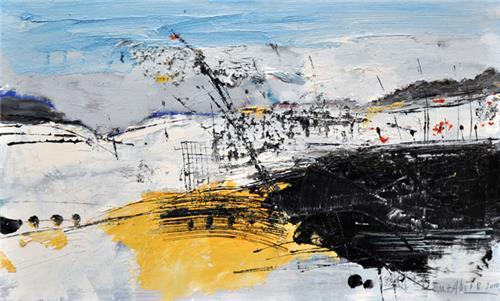
Without hesitating to evoke any other phenomenon, the landscape that appears before us at first glance is the earth itself – closed in upon itself, yet in the motion of opening onto the world. The horizontal depth positioned in the northern part of the panoramic composition makes clear the physical distinction between the perceptible “here” and the imperceptible “beyond”, while also bringing what lies beyond the horizon into a position of imaginable nearness; for what is here is also what is beyond. The tectonic stirring that makes itself felt within a strong sense of gravity takes hold of the viewer as an experience of perception. The patches of colour depicting the earth – at times tremulous and transparent, at times dense and crust-like – tend to slide towards the lower edge of the surface, while the depth of the horizon, fixed and calm, stands in the painting as a dialectic of opposition. As Zahit Büyükişliyen intervenes against the real appearance of nature by erasing and rebuilding, we see a hidden geometry of leaping lines positioned within a milieu that seems uncontrolled yet is no less vital. The geometry secretly embedded in the informel stands for the logic that governs the instinctive and the intuitive. The expressive duality between the looseness and calculated expansiveness of the broad patches and the dynamic leaps of the lines, conveying agility and speed, alludes to the conflict between nature and the science that seeks to bring nature under control. Warm touches scattered as small explosions within the spreading patches act in the painting as dynamic physical agents representing the formation of the earth’s surface. In Büyükişliyen’s works we encounter the abstract imagery of the earth opening itself to the world and evolving from the hidden to substance. The massive black patches evoke carbonised matter, while the warm yellow ones recall the earth’s crust in the very process of formation. Masses of colour of a luminous (transparent, warm) and lightless (dense, greyed) consistency, set on the same plane and even flowing into one another, give the viewer a sense of an abstract metaphysical imagery – just as day and night are presented within one unified field of perception in the paintings of René Magritte.
While the nature Büyükişliyen paints designates space as the principal agent of the movement of formation, the void appears as an energy that makes movement possible. This aesthetic relationship between the order of becoming in nature and the order of becoming in the painting also contains a tendency that internalises the “order of becoming” of the Surrealists who turned to automatism. The “wandering lines”, perceived as uncontrolled expressive lines, become – rather than pursuing a form – the very object of movement. We may say that the nature devoid of the human figure in Büyükişliyen’s paintings is not a nature purged of human beings. That the eye and the hand in the painting carry an expression of nature is a more enterprising approach than an anthropocentric understanding of representation. It advocates an action embodied out of concern not to “correct nature” but to correct the human being. I think we may leave the text here and return to the work with the words of Willem de Kooning: “I find it absurd, the idea that nature is chaotic and that the artist has to put order into it; the order we must establish is within ourselves…”3
Ümit İnatçı
1 John Locke, Essays on the Law of Nature. · 2 Giorgio Agamben, L’aperto. · 3 Barbara Hess, Abstract Expressionism.
The Search for Identity and Originality in the Visual Arts
In this article, published in 1987 while he was Head of the Department of Painting at the Faculty of Fine Arts, Hacettepe University, Büyükişliyen discusses the place of art in the formation of a country’s cultural identity and the relationship the state ought to establish with art. His starting point is clear: works of art are the concrete forms of a country’s culture, and this heritage can only be built up through serious labour sustained over centuries; it cannot be left to weekend painters or to hobbyist pursuits. The task of the state is to create a free environment in which artists can produce original work without being bound to a particular political view or slogan.
The author grounds this argument in an examination of how Turkish painting became institutionalised from the early years of the Republic. Painting, which in İstanbul had seemed an extension of court art, gained a new focus of attention when Ankara became the capital. The Society of Turkish Painters opened its first Ankara Exhibition at the Türk Ocağı on 29 October 1923; in 1926 the society became the Union of Fine Arts (Sanayi-i Nefise Birliği), and in 1929 the Fine Arts Union (Güzel Sanatlar Birliği). In the words of the painter Hamit Görele, the move from İstanbul’s “still waters” and “weary evenings” to the “rugged nature” of the steppe demanded a new way of seeing in painting as well.
The article shows with concrete figures how the state supported art in this period: 2,500 people visited the fourth Ankara Exhibition in 1927, and 34 paintings were purchased. Atatürk congratulated artists and bought paintings from them, an attitude that spread to the ministries and the bureaucracy. The young generation returning from Europe founded the Association of Independent Painters and Sculptors in 1928 and the D Group in 1933. The opening of the art and crafts section of the Gazi Teacher Training Institute (1932), the Revolution Painting Exhibitions (from 1933), the painters’ tours of the country (1938) and the founding of the State Exhibition of Painting and Sculpture are listed as the steps that turned Ankara into an artistic centre.
At the heart of the article is AR, the magazine that painters in Ankara published in 1937 with their own resources. Through a survey entitled “The Visual Arts and Türkiye”, the magazine opened up debate on the place of art in national culture and on the “nationalisation of art”. Büyükişliyen particularly emphasises the criticism levelled at the Revolution Painting Exhibitions: according to Burhan Belge, by placing subject matter before art these exhibitions harmed both the revolution and art; every fine work made in Türkiye was in any case a work of the revolution. Cemal Tollu and Nurullah Berk likewise argued that the state should protect art, but that imposing particular subjects, as in the Soviet Union, Germany and Italy, would paralyse it.
Büyükişliyen links this debate to his own day: the clichéd symbolism of works bought under the label of “revolution painting” (Ankara Citadel, factory chimneys, rearing horses, ox-carts carrying ammunition) was still winning prizes in the competitions of the 1980s. In his view the problem is the lack of a well-defined cultural and arts policy, which had persisted unresolved since the 1930s.
In the conclusion the author states his position plainly. As long as art is obliged to conform to boundaries and slogans set by the state, only a degenerate art “held captive by narrative” can be produced, and this runs counter to art’s nature, which is to find the new and to surpass itself. In Türkiye, under single-party and multi-party rule alike, free art has been possible only through uncompromising individual initiatives. Instead of always expecting sacrifices from the artist, the state should protect the artist and, in return, provide a free environment. For Büyükişliyen, an artist who grows up in a free and democratic environment will reach both the national and the universal through his or her work.
M. Zahit Büyükişliyen
Source: M. Zahit Büyükişliyen, “Plastik Sanatlarda Kimlik Arama ve Özgünlük” (The Search for Identity and Originality in the Visual Arts), Sanat Yazıları, no. 2, Faculty of Fine Arts, Hacettepe University, Ankara, 1987, pp. 35–46. Full text of the article on DergiPark (in Turkish). Summary of the article.
Principal sources cited in the article: Nurullah Berk, Türkiye’de Resim (Academy of Fine Arts Publications, 1943); Gültekin Elibal, Atatürk ve Resim-Heykel (İş Bankası Cultural Publications, 1973); Elif Naci, “10 Yılda Resim” (1933) and “1923’den 1928’e Kadar Plastik Sanatlar” (Ülkü, 1938); Hamit Görele, “8. Devlet Resim ve Heykel Sergisi” (Ulus, 1947); Turan Erol, “Başkent Ressamlar Resim Sergisi” (BRHD Bulletin, 1979); articles from AR magazine (1937–1938): Cemal Tollu, “Bir Anket Münasebetiyle”; Nurullah Berk, “Sanat ve Devlet”; Hasan Ali Yücel; “Dördüncü İnkılâp Resim Sergisi”.
Landscape in the Context of Gestural Abstraction and Surrealist Approaches
In this 2025 research article, Dr. Mevlüt Özemir of the Faculty of Fine Arts, Kırıkkale University, examines how the theme of landscape in contemporary Turkish painting between 1950 and 2024 was transformed through gestural abstraction and surrealist approaches. Büyükişliyen is one of four artists chosen for their “consistent stance” on the subject; the others are Adnan Turani, Hakan Esmer and Barış Sarıbaş.
According to the article, Büyükişliyen believes that every artist must create the materials and techniques suited to his or her own nature, and regards this as the first step in setting creative power in motion. As a student he worked not only in painting but also on abstractions of figure, space and nature in linocut, lithography and intaglio, treating the relationships of form, line, colour, patch and texture as fundamental problems of composition. In 1965, at the age of nineteen, one of his works was accepted for the State Exhibition of Painting and Sculpture. The works of this period reflect a tachiste approach in which black and white predominate, accompanied by line.
The author quotes two assessments of the artist. In 1982 his teacher Adnan Turani identified the “abstraction through estrangement” of natural images as the salient new feature of his painting. In 2000 İnci Aral found the originality of this painting in the way it keeps the dialectical relationship between content and form, objective and subjective, in balance: the painting stands between the abstract and the concrete and, drawing on the possibilities of both, expands its own boundaries.
The core of the article is the analysis of three works. Eskişehir Days I (2010, 150 × 150 cm) is read as a “mental landscape” built with energetic brushstrokes, in which a gestural sky and the horizon line mark the boundary between reality and imagination. You and I (2015, 100 × 70 cm) contains, in a landscape divided in two by yellow and brown tones, patches suggesting mountains, a lake and ships, and two human silhouettes looking out over the scene; the author interprets these two figures as different reflections of the same self, an image of inner searching. Untitled (2017, 70 × 70 cm) is built on the contrast between a calm, flat blue field and the chaotic black, yellow and brown patches in the lower part: consciousness and the unconscious, order and disorder, dream and reality. All three works are considered within “expressive theory”.
In conclusion, the article states that Büyükişliyen’s abstracted landscapes bear the marks of contemporary aesthetics, drawing on the possibilities of technology without clinging rigidly to traditional techniques. Problems such as the degradation of nature, the nuclear threat, unplanned urban growth and industrialisation are reflected in these paintings. In the author’s view, with their bright gestural colours, rich textures and ambiguous figures, these works invite the viewer to a questioning gaze and are original works that interrogate both the complexity of modern life and the calm of nature.
Dr. Mevlüt Özemir
Source: Mevlüt Özemir, “Çağdaş Türk Resminde Lekesel Soyutlama Bağlamında Peyzaj Teması ve Gerçeküstü Yaklaşımların Biçimsel Yansımaları” (The Landscape Theme in Contemporary Turkish Painting in the Context of Gestural Abstraction and the Formal Reflections of Surrealist Approaches), Socrates Journal of Interdisciplinary Social Researches, vol. 11, no. 52, 2025, pp. 46–66. DOI: 10.5281/zenodo.15315473. Summary of the section of the article on Büyükişliyen (pp. 52–56, 64).
Sources on Büyükişliyen cited in the article: Adnan Turani, “Zahit Büyükişleyen’in Resmi Hakkında”, Yeni Boyut Sanat Dergisi, 1(7), 1982, p. 24; İnci Aral, Zahit Büyükişleyen: Gökle Yer Arasında (Bilim Sanat Galerisi Publications, 2000), p. 84; İsmail Ateş, “Mehmet Zahit Büyükişleyen ve Soyut Peyzajları Üzerine Bir İnceleme”, Sanat ve Tasarım Dergisi, 1(1), 2011, pp. 15–24; Ömer Faruk Şerifoğlu, Yeldeğirmenlerine Karşı: M. Zahit Büyükişleyen Retrospektif Sergi (Zeytinburnu Culture and Art Centre Publications, 2023); Mevlüt Özemir, Çağdaş Türk Resminde Lekesel Soyutlama Bağlamında Peyzaj Teması (doctoral thesis in art, Selçuk University, 2024). The spelling of the artist’s name has been left as it appears in the sources.
Abstract Tendencies in Turkish Painting after 1950
This master’s thesis, written by Serpil Akdağlı in 2007 at the Institute of Social Sciences of Atatürk University, examines the course of abstract art in Turkish painting after 1950 and the artists who worked in this field. The artists are grouped as geometric and lyrical abstractionists, geometric and lyrical non-figurative painters, and “other contemporary tendencies”. Büyükişliyen is discussed in this last section together with Şadan Bezeyiş, Burhan Doğançay, Erol Akyavaş, Hasan Pekmezci, Şükrü Aysan, Hüsamettin Koçan and Bedri Baykam.
According to the thesis, for Büyükişliyen – who has no connection to any traditional form and uses the calligraphic element or the source of colour without any concern for harmony – abstract expressionism is a way of life. During his years as a teacher at the İvriz Teacher Training School at the foot of the Taurus Mountains, he made his first abstract experiments by painting the calm, the silence and the movements of the steppe. The artist, who had wanted to work figuratively, decided after encountering the art scene during his studies in Germany that thought must enter painting, and he combined the visual elements with the conceptual.
The thesis also includes Kıymet Giray’s assessment of 1992: the artist, who produces through a dynamic act before the canvas and engages in an unending reckoning and questioning, creates the content of his painting through the force of unconscious impulses and turns towards the expressionist mode of abstract expression.
On his return to Türkiye he sought to express in pictorial terms the subject of his theoretical thesis – rural-to-urban migration and unplanned urbanisation – placing city plans and the gecekondu houses built over them in his paintings. He treats environmental problems through conceptual elements in order to make the viewer think, yet he does not regard painting as a vehicle for narration; he believes that painting serves its own ends. As an example of this period the thesis examines The Unbearable Radiance of Red (1992): an atmosphere that might be called an “abstract landscape”, in which colour, patch and line reach an exuberant dynamism. Moving from the crystallising interpretations of the sky to sections of nature is left to the viewer’s interpretation.
Drawing on Ümit Gezgin, the thesis notes that the intellectual dimension behind the artist’s modest personality led him to look at existence philosophically and to unite a visuality of intellectual depth in an original visual expression. In the fortieth year of his art, Büyükişliyen organises a conceptual space by painting stones, creating illusionistic space and lifting the composition into a visual-intellectual dimension. Collage Series on Stones (2006) is an example: in these balanced works, constructed around an idea of order, the stones both form a realm of being and, by creating a new space, establish the intellectual ground. According to the thesis, the artist has perceived the world beyond the reality it presents and has always reflected this “self-reality” in his work.
Serpil Akdağlı
Source: Serpil Akdağlı, Abstract Tendencies in Turkish Painting after 1950 (Abstract Tendencies in Turkish Painting after 1950), master’s thesis, Institute of Social Sciences, Department of Painting, Atatürk University, Erzurum, 2007 (supervisor: Assoc. Prof. Dr. Fikret Haşimov), section 4.7, pp. 75–77. Summary of the section of the thesis on Büyükişliyen.
Sources cited in this section: Kıymet Giray, “Zahit Büyükişleyen’in Resimlerinde Doğa Kesitleri ve Renk Coşkuları”, Sanat Çevresi, no. 164, June 1992, p. 47; Ümit Gezgin, “Zahit Büyükişleyen Resminde Kurgu ve Düzen Estetiği”, Artist Dergisi, no. 4/77, April 2007, p. 83. The spelling of the artist’s name has been left as it appears in the sources.
Training Teachers for Art Education and the Difficulties Encountered
In this article, published while he was an associate professor at the Faculty of Fine Arts, Hacettepe University, Büyükişliyen addresses the problems of training teachers of art. His starting point is the Basic Law on National Education of 1973: teaching is a specialised profession requiring general culture, subject training and pedagogical formation. In the author’s view, the general problems of teacher training – inadequate resources, lack of equipment, the unattractiveness of the profession, differences between institutions and short teaching placements – have grown even larger in art education and turned into “utter chaos”, reducing art education to a subject that exists in general education in name only.
Büyükişliyen groups the difficulties under five headings. Selection of candidates: university entrance examinations measure knowledge, not artistic ability or creativity. Art and crafts departments are largely filled with students who could not be placed elsewhere, and the obligation to fill quotas renders the aptitude test ineffective. Yet a good art educator is an “artist-teacher”: he or she must possess artistic culture, creative intelligence and practical ability. Inadequate curricula: art education is not merely a subject taught in secondary school or an activity for gifted children, but a whole that begins in pre-school and aims at the individual’s healthy participation in society. Yet in the curricula, art and subject-teaching methodology courses make up only a very small share of the total.
Differences between institutions: art teachers are trained in five different types of institution, and subject-teaching methodology courses are often taught by non-specialists. Inadequate facilities and equipment: the author calls for well-equipped studios, a specialist library rich in catalogues and reproductions, archives and laboratories in which children’s work is kept not as works of art but as documents of development, practice schools, and research centres to study regional differences. In his view a candidate trained through teaching placements of only 15–20 days is like someone who has learned to swim in theory on dry land and is then thrown into deep water. Lack of scholarly publications: in a country of more than fifty million people, the number of books available to a prospective art teacher does not exceed eight.
The article ends with a call: to overcome these difficulties, we must first believe wholeheartedly in one thing – the necessity of art education. For the author, art education exists so that every individual’s personality can fully develop and become whole.
M. Zahit Büyükişliyen
Source: Assoc. Prof. M. Zahit Büyükişliyen, “Sanat Eğitimi İçin Öğretmen Yetiştirme ve Bu Konuda Karşılaşılan Güçlükler” (Training Teachers for Art Education and the Difficulties Encountered), Hacettepe Üniversitesi Eğitim Fakültesi Dergisi (Hacettepe University Journal of Education), no. 2, 1987, pp. 169–175. Full text of the article (journal archive, in Turkish). Summary of the article.
The Theme of Migration in Turkish Painting from 1960 to the Present
This 2025 article by Dr. Gülseren Budumlu İldeş and Meral Balcı Gümüş of Sakarya University examines the theme of migration in Turkish painting after 1960 through the concepts of identity, belonging and memory. Three artists who themselves experienced migration and made it the subject of their art were selected: Hüseyin Bilişik, Ramiz Aydın and M. Zahit Büyükişliyen. According to the authors, Büyükişliyen addresses social issues such as rural-to-urban migration, unplanned urbanisation and the gecekondu in an expressionist, conceptual language that aims to make the viewer think.
The article emphasises that the artist reflected his own journey of migration – beginning in İskenderun and continuing through Ankara, Konya, Germany and back to Ankara – in his art. The Kassel years were decisive: seeing Joseph Beuys’s works at documenta 5, curated by Harald Szeemann in 1972, led him to question everything he had learned until then and moved his work into an intellectual, theoretical dimension. Influenced also by Rauschenberg’s and Lichtenstein’s use of silkscreen, the artist transferred photographs onto canvas by screenprinting, intervened in them with oil paint and gave his painting a conceptual effect through collage and montage. The subject of his thesis at the academy was likewise the interpretation in Turkish painting of rural-to-urban migration and of the gecekondu settlements on the edges of cities.
The authors examine five works. Apple Orchard in İvriz (1968) depicts an apple orchard under snow in İvriz, where he had been appointed as a teacher; with its dense paint, palette-knife marks and first signs of fragmentation, it is a landscape that resists the winter like the people of Anatolia. The artist says that here he imagined “unearthly colours”. In the etching Migration (1976), figures that belong to no particular place, dissolving into black silhouettes, walk towards gecekondu houses stretched like a band across the top; migration appears as a journey into the unknown. Shanty Houses (1976) has two planes: below, a bird’s-eye view of piled-up gecekondu houses; above, their floor plans – the roofs that symbolise a family’s sacred home are virtually stacked on top of one another.
Consequences of Migration (1988) is built around a photograph of a gecekondu demolition transferred onto canvas by screenprinting. The triangle above the photograph recalls a roof; two red drops trickling down from it evoke the pain and disappointment suffered. According to the authors, this work shows that the artist does not regard painting merely as a combination of line and paint, but considers a social stance necessary as well. Finally, Shanty Houses in Ankara (2019), exhibited in İstanbul in 2025, returns to the unplanned urbanisation caused by rural-to-urban migration: it is an indication of how people change their environment and how the environment changes people.
In its conclusion, the article assesses Büyükişliyen’s migration and gecekondu works as examples of contemporary art that, besides carrying a national language, are original, conceptual and open to reflection. The artist’s gaze is centred not on being looked at but on making people think – not, however, by delivering a message, but by provoking thought within artistic production.
Gülseren Budumlu İldeş – Meral Balcı Gümüş
Source: Gülseren Budumlu İldeş and Meral Balcı Gümüş, “1960’tan Günümüze Türk Resminde Göç Teması: Hüseyin Bilişik, Ramiz Aydın, M. Zahit Büyükişliyen” (The Theme of Migration in Turkish Painting from 1960 to the Present), Turkish Studies, 20(3), 2025, pp. 1325–1357. DOI: 10.7827/TurkishStudies.81705 (full text). Summary of the section of the article on Büyükişliyen (pp. 1345–1353).
Principal sources on Büyükişliyen cited in the article: İnci Aral, Zahit Büyükişleyen: Gökle Yer Arasında (Bilim Sanat Galerisi, 2000); İsmail Ateş, “Mehmet Zahit Büyükişliyen ve Soyut Peyzajları Üzerine Bir İnceleme”, Sanat ve Tasarım Dergisi, 2011; Ş. Çinici, Yersiz: İsimsiz Öteki Hikâyeler, catalogue of the Öteki Hikâyeler exhibition, Bilgi University (2024); Tünel Sanat Galerisi Sergi Kataloğu (2000). Details of the works are given according to the catalogue information on this site; in the article, Migration is listed as 24.5 × 31.5 cm.
The City as Image in Contemporary Turkish Printmaking
This master’s thesis, written by Sercan Koçak in 2017 at Yaşar University, examines how the city, its problems and urban society became images in Turkish printmaking after the founding of the Republic. The thesis cites Büyükişliyen as an example of printmakers who address the troubled districts of the city and the problems of those who live there on an abstract plane.
After graduating from the Gazi Institute of Education in 1967, the artist worked on abstractions of figure, space and nature in printmaking techniques as well as on canvas. At the Kassel State Academy of Fine Arts, to which he went on a state scholarship in 1971, he trained in lithography, screenprinting and etching, producing mainly urban abstractions during these years. In these works, in which expressionist features come to the fore, he explored new directions in printmaking through collage and montage. According to Kemal Özsezgin, the artist sought a way of pursuing canvas and print together, each according to its own logic, without losing the freshness, calm and visual exuberance of painting. City silhouettes, architectural drawings, geometric signs, cutting, transferring, repetition and collage give rise to works with an effect of “incompleteness”.
When he returned to Türkiye in 1976 and began teaching at the Gazi Institute of Education, he adopted a critical stance towards unplanned urbanisation and air pollution, and the expressiveness of his painting became more pronounced. The thesis attributes this to the deep gulf between Germany and the turbulent Türkiye of the years before 12 September 1980, to population growth, unemployment and to the air pollution in Ankara, which had risen to deadly levels. While these problems troubled the artist, they also became material for his painting; yet he delivers no direct message, building his painting on an abstract plane and leaving it to the viewer’s intuition.
The examples chosen by the thesis, Our Parts of the World and From Beytepe to Altındağ (1989), are among the abstract compositions the artist built in 1988–89 using the possibilities of photography, screenprinting and collage, and they show that he had entered a new technical phase. The movement achieved through the repetition of filled squares and rectangles creates a striking effect both graphically and perceptually. These abstractions, built with the possibilities offered by technology, reflect the degradation of nature and natural life, the nuclear threat, and the hardships caused by unplanned urbanisation and industrialisation.
Sercan Koçak
Source: Sercan Koçak, The City as Image in Contemporary Turkish Printmaking (The City as Image in Contemporary Turkish Printmaking), master’s thesis, Institute of Social Sciences, Department of Graphic Design, Yaşar University, İzmir, 2017 (supervisor: Asst. Prof. Nazlı Gürgan), pp. 37–39. Full text: National Thesis Centre of the Council of Higher Education (YÖK), thesis no. 477358. Summary of the section of the thesis on Büyükişliyen.
Sources cited in this section: Kemal Özsezgin, Zahit Büyükişliyen Sanatta 40. Yılı (İMGS Art Publications, 2006), p. 29; İsmail Ateş, “Mehmet Zahit Büyükişliyen ve Soyut Peyzajları Üzerine Bir İnceleme”, Sanat & Tasarım Dergisi, 2011, pp. 19–21. Details of the works are given according to the catalogue information on this site; the thesis lists From Beytepe to Altındağ as a screenprint.
On the Formation of Contemporary Art and the Traditionalists
Büyükişliyen opens this article, written while he was an assistant professor at the Faculty of Fine Arts, Hacettepe University, with the urinal that Marcel Duchamp wanted to exhibit in New York in 1917. Duchamp had not made the object, only chosen and signed it; the work was rejected and became a scandal. Yet, the author says, a look at the art of the last twenty-five years is enough to see Duchamp’s influence on Pop Art, Op Art and Happenings. With a path leading from Fauvism to Cubism and from Futurism to the “readymade”, Duchamp is one of those who opened the door to contemporary art.
Even so, Büyükişliyen questions whether it is right to tie contemporary art to a single date or a single person. Some see its beginning in the Salon des Refusés of 1863 and in Bergson’s thoughts on intuition, some, like André Malraux, in Goya and Manet, and others in Cézanne, who sought a geometric structure. Some art historians link the beginning to non-objective expression: between 1909 and 1913, in Paris, Munich, Moscow and Zurich, artists such as Kandinsky, Larionov, Malevich, Delaunay and Arp produced abstract works that broke with tradition, unaware of one another. After the Second World War, Abstract Expressionism, Pop, Minimal and Conceptual Art followed one another in rapid succession; the line separating painting from sculpture was broken and new possibilities of the object emerged.
According to the author, innovation has always met with resistance; Picasso and Dalí, opposed yesterday, are today classics of modern art. Türkiye, however, is in a period in which every artistic event is viewed through the lenses of “traditional Turkish painting” and “local flavour”, in which painting other than oil and sculpture other than bronze and marble are not accepted, and in which the object, which ought to be a means, is regarded as an end. Büyükişliyen sees this as a process that our Western-oriented visual arts, with a history of less than a hundred years, must necessarily go through.
The article illustrates this process with Turkish examples. Eşref Üren, whose works were rejected by the State Exhibition in 1939 and who had defended contemporary painting, changed his position after the 1950s to the point of saying “To me, abstract art is nonsense.” In 1974 a “Mirror” accepted for the 35th State Exhibition of Painting and Sculpture became, as a readymade fifty-seven years after Duchamp’s urinal, the target of mocking criticism. In 1979 Remzi Savaş’s monumental inflating and deflating balloons and the New Tendencies exhibitions of Mimar Sinan University met with similar attacks. Yet the author remains hopeful: despite all traditionalists, stereotyped views and commercial calculations, our visual arts will sooner or later take their place within contemporary art.
M. Zahit Büyükişliyen
Source: Asst. Prof. Dr. M. Zahit Büyükişliyen, “Çağdaş Sanatın Oluşumu ve Gelenekçiler Üzerine” (On the Formation of Contemporary Art and the Traditionalists), Sanat Yazıları, no. 1, Faculty of Fine Arts, Hacettepe University, Ankara, 1987, pp. 33–38. Full text of the article on DergiPark (in Turkish). Summary of the article.
Sources cited in the article: Jürgen Weber, Pop Art (Heinz Moos Verlag, Munich, 1968); Leopold Zahn, Kleine Geschichte der Modernen Kunst; André Malraux, Psychologie der Kunst; Kaya Özsezgin, “Eşref Üren”, supplement to Milliyet Sanat Dergisi, 1 December 1981; Yurdakul Fincancıoğlu, interview with Eşref Üren, Zafer, 13 May 1955; Kaya Özsezgin, “Aynalı Sergi” (The Exhibition with the Mirror), Sanat magazine, 1 July 1974.
A Look at Global Warming and Climate Change in Contemporary Turkish Painting
This 2023 review article by İlyas Sevindik of Amasya University examines how global warming and climate change are reflected in contemporary Turkish painting. In the author’s view, the destruction of nature that has grown since the Industrial Revolution has also led artists to make nature liveable once more and to remind people of it. In the article Büyükişliyen is discussed as one of the artists who have produced work on this subject, alongside Neşet Günal, Yasemin Sayıbaş Akyüz, Azade Köker, Göksu Gül and Murat Akagündüz.
According to the author, Büyükişliyen, who has painted pictures on the problems of environmental pollution, technology and urban life, has developed an abstract, expressionist and conceptual mode of expression rooted in nature. In his works bearing witness to the destruction of the environment by human hands, the explosion at the Chernobyl nuclear power plant and the clouds of radiation were among the principal factors that affected him. The degradation of nature and natural life, the nuclear threat, unplanned urban growth, the hardships brought about by industrialisation and references reaching as far as Hiroshima long occupied a place in his paintings. In these works, colours and forms voice a tension, an unease.
The article’s example, From Chernobyl to the Black Sea (1988), is read as an indication of the damage humans have done to nature and of how short distances have become: bright reds, blacks, yellows and blues give the viewer the feeling of being swallowed up. The author regards this painting as a progressive approach that recognised in its own day an environmental problem whose effects would last for decades. In his view, with paintings that tell how “destruction came before the flood”, Büyükişliyen draws attention to the relationship between nature, environment and humankind while also revealing the inner unease he feels on behalf of humanity. In the conclusion, the artist is cited as one who addresses the hardships caused by technology on a global scale and approaches the destruction of the environment from a different perspective.
İlyas Sevindik
Source: İlyas Sevindik, “Sanatsal Yorumlarla Çağdaş Türk Resminde Küresel Isınma ve İklim Değişikliğine Bakış” (Glance at Global Warming and Climate Change in Contemporary Turkish Painting with Artistic Commentary), ArtGRID – Journal of Architecture, Engineering & Fine Arts, 5(1), 2023, pp. 100–109. DOI: 10.57165/artgrid.1269967 (full text). Summary of the section of the article on Büyükişliyen (pp. 103–104, 108).
Sources cited in this section: Zeynep Yasa Yaman, Kayıt (Central Bank Banknote Printing Works, 1993), p. 55; İsmail Ateş, “Mehmet Zahit Büyükişliyen ve Soyut Peyzajları Üzerine Bir İnceleme”, Sanat ve Tasarım Dergisi, 1(1), pp. 21–22; İnci Aral, Zahit Büyükişleyen (Bilim Sanat Galerisi, 2000), pp. 120–124.
The Cultural and Artistic Milieu in Türkiye, 1970–1980
This doctoral thesis, written by Güler Bek Arat under the supervision of Zeynep Yasa Yaman, examines the art scene of the period that began with 12 March 1971 and ended with 12 September 1980, together with its political, economic and social developments. Büyükişliyen does not have a chapter of his own in the thesis, but appears several times in the chapters on the educational institutions of the period, the new generation in abstract art and the subjects artists addressed. This summary brings those passages together.
Studies abroad and Gazi: The thesis relates that the tradition of sending students of the art and crafts department of the Gazi Institute of Education abroad continued in the 1970s. Together with Zafer Gençaydın, Halil Akdeniz, Remzi Savaş, Mehmet Güler and other artists, Büyükişliyen went to Germany during this period. Most of those who returned joined the teaching staff of Gazi in the 1970s. The years in which the artist took up his post in 1976 were years in which the polarisation between right and left deeply affected the school. The thesis quotes İnci Aral’s account: the school was closed because of clashes on the very day it opened, and remained closed almost continuously for the first two years; in the halls where balls and plays had once been held, young people now beat and killed one another. Even after the administration changed in 1978, the division persisted.
A new generation in abstract art: According to the thesis, while abstract art between 1970 and 1980 was carried on mainly by the mature generation of the Republican era, young artists such as Ömer Uluç, Zafer Gençaydın, Güngör Taner, Halil Akdeniz, Mehmet Güler and Büyükişliyen also worked in this direction and brought new openings to the geometric-lyrical abstract idiom. A distinctive feature of this generation is the blurring of the boundary between the figurative and the non-figurative: while using an abstract language, they refer to social issues such as environmental pollution and politics, and to the inner world of the human being. Having painted Anatolia and everyday life as students, these artists turned to abstraction on returning from abroad, yet never broke entirely with the figure.
Unplanned urbanisation and the environment: The thesis treats the environmental problems brought onto the agenda by unplanned urbanisation as a distinct subject in the painting of the period, and cites Büyükişliyen as the first example. The artist, who wrote a thesis on rural-to-urban migration, unplanned urbanisation and the gecekondu during his studies at the academy, addresses in his works the process by which people change their environment and the environment changes people, as well as environmental pollution.
Exhibitions, awards and Ankara: The chronology of exhibitions in the appendix of the thesis records that Büyükişliyen received an honourable mention at the 10th DYO Painting Competition in 1976 and an award of merit in the painting section of the 38th State Exhibition of Painting and Sculpture in 1977. In the concluding assessment, describing how Ankara artists gathered around the United Painters and Sculptors Association and how, under the influence of Gazi, an artist profile specific to Ankara emerged, the thesis mentions Büyükişliyen’s study “Ankara Painters”, prepared under the supervision of Özdemir Altan, as one of the signs of this spontaneous grouping.
Güler Bek Arat
Source: Güler Bek Arat, The Cultural and Artistic Milieu in Türkiye, 1970–1980 (The Cultural and Artistic Milieu in Türkiye between 1970 and 1980), doctoral thesis (supervisor: Zeynep Yasa Yaman), 2007; e-publication by SALT/Garanti Kültür AŞ, 2014. Full text of the thesis at SALT (in Turkish). Summary of the passages of the thesis that mention Büyükişliyen (pp. 97–98, 176–177, 184, 198 and the exhibition chronology).
Sources cited in these passages: İnci Aral, Zahit Büyükişleyen: Gökle Yer Arasında (Bilim Sanat Galerisi, 2000), pp. 64, 73–74, 78; Zahit Büyükişleyen, Türk Resminde Ankaralı Sanatçılar (Sanatyapım, 1991), pp. 90, 93, 104, 110. The images above do not appear in the thesis; they are examples from this site of the artist’s works of the period on environmental and urban themes.
Expression and Abstraction Tendencies as Tools of Expression in the Expressionist Conception of Art
This master’s thesis, written by Selçuk Işık at Trakya University in 2025, examines the emergence of abstract tendencies and of abstract art through the lens of Expressionism. It explores how changes in the perception of reality were reflected in painting, the psychological needs underlying abstraction, and means of deforming form such as stylisation and deformation. It also discusses the influence of the ideas of Nietzsche, Bergson, Freud and Marx on the movement, and the marks left on artists by the two world wars.
The artists cited as examples in the thesis are: International: Paul Cézanne, Vincent van Gogh, Paul Gauguin, Edvard Munch, Henri Matisse, Maurice de Vlaminck, André Derain, Raoul Dufy, George Grosz, Otto Dix, Emil Nolde, Ernst Ludwig Kirchner, Erich Heckel, Oskar Kokoschka, Egon Schiele, Käthe Kollwitz, Wassily Kandinsky, Pablo Picasso, Amedeo Modigliani, Alberto Giacometti, Francisco de Goya, William Turner, John Constable, Claude Monet, Theo van Doesburg, Umberto Boccioni, Marcel Duchamp, Raoul Hausmann, John Heartfield and René Magritte. From Türkiye: Ferruh Başağa and Zahit Büyükişliyen.
Yaklaştıkça (As It Draws Nearer) (As It Draws Nearer), 50 × 30 cm, oil on canvas
Büyükişliyen is discussed in the chapter on Expressionist artists. After graduating from the art and crafts department of the Gazi Institute of Education and specialising at the Kassel Academy of Fine Arts, the artist spent many years painting, in an expressionist manner, the environmental pollution caused by industrialisation and urbanisation. The thesis quotes the artist’s own words: “If I can unsettle, then I am issuing a warning. I am, first of all, someone who does not stand apart from society’s problems but lives in their midst. I am someone who hears, who senses.” Having made abstractions from nature in his early periods, the artist over time built his own atmosphere in painting and arrived at an entirely constructed abstraction. He first makes a print on the canvas and then works over it, producing expressionist works through patch, line and the texture of paint. The thesis includes his painting Yaklaştıkça (As It Draws Nearer) (As It Draws Nearer) as an example.
Selçuk Işık
Source: Selçuk Işık, Expression and Abstraction Tendencies as Tools of Expression in the Expressionist Conception of Art (Expression and Abstraction Tendencies as Tools of Expression in the Concept of Expressionist Art), master’s thesis, Institute of Social Sciences, Department of Painting, Trakya University, Edirne, 2025 (supervisor: Prof. Dr. Mustafa Haykır), p. 76. Full text: National Thesis Centre of the Council of Higher Education (YÖK), thesis no. 923426. Summary of the thesis and its section on Büyükişliyen.
Source cited in this section: Halkbank Koleksiyonu (TŞOF Plaka Matbaa, Ankara, 2000), p. 114. The image is taken from the thesis; the year of the work is not given there.
How Works of Art Are Made Sense of and Their Communication with the Viewer
This 2015 article by Ahmet Kürşad Albayrak of the Faculty of Fine Arts, Erciyes University, asks how a work of art opens itself to the viewer and how it acquires meaning. According to the author, the perception of a work depends as much on the viewer’s awareness of the artist’s accumulated knowledge as on the artist nourishing himself through reading, travel and research; it is precisely at this point that communication arises. The article discusses this question through works by artists such as Paul Klee, Jennifer Pastor, Russell Crotty and Trevor Paglen, a traditional example of calligraphic painting, and paintings by Zahit Büyükişliyen.
The author observes that Büyükişliyen’s works offer striking clues as to how they are made sense of. That the artist named one of his exhibitions “Interpretations” shows the place of interpretation in his painting. Drawing on Kemal Özsezgin, the author notes that notes taken from nature can be seen in his paintings, but that over time the artist embarked on new searches concerning the reality of nature; and he stresses that if we speak of a work of art today, style and the skill of interpretation should not be cast aside.
From the exhibition Güz Dönüşümleri (Autumn Transformations), 2014
Drawing on the retrospective exhibition at the Kibele Art Gallery (20 December 2012 – 2 February 2013), the article also summarises the artist’s path: having initially worked in close connection with nature, Büyükişliyen embarked on abstract experiments; his move to Germany, seeing its metropolises and museums, taking part in biennials and following documenta were decisive in prompting him to rethink the boundaries of his art. In the course of this process his painting settled into an abstract expressionist and, after his return to Türkiye, a conceptual expressionist line, shaped by environmental problems and by his sensitivity as an individual. The examples are a painting from the 2014 exhibition Autumn Transformations and Déjà Vu II (2011).
Ahmet Kürşad Albayrak
Source: Ahmet Kürşad Albayrak, “Sanat Yapıtlarının Nasıl Anlamlandırıldığı ve İzleyiciyle İletişimine Dair Bir İnceleme” (An Analysis of Making Sense of Artworks and Their Communication with Audiences), Erciyes Sanat, no. 4, Erciyes University, 2015, pp. 11–22. Full text of the article on DergiPark (in Turkish). Summary of the section of the article on Büyükişliyen (pp. 17–18).
Sources cited in this section: Kemal Özsezgin (2009), p. 65; ekavart tv, video “Zahit Büyükişliyen Retrospektif Sergisi” (Kibele Art Gallery, 2012–2013). The title of the painting from the Autumn Transformations exhibition is not given in the article.
Videos
Interviews and programmes (in Turkish)
Retrospective exhibition · 2023
Yeldeğirmenlerine Karşı
Dates
6 January – 19 March 2023
Venue
Kazlıçeşme Sanat, Zeytinburnu, İstanbul
Curators
Ömer Faruk Şerifoğlu, Dr. İlona Baytar
Against the Windmills: a comprehensive selection spanning 1964 to 2022. The journey of an artist who for more than half a century has been sounding an “early warning” about air pollution, migration and unplanned urbanisation – from the steppe of İvriz to Kassel, from Ankara to İstanbul, from Don Quixote to İskenderun.
Biography
Ankara, 1977
One of the pioneers of abstract painting in Türkiye; a painter and educator who brings together organic forms drawn from nature with intellectual forms.
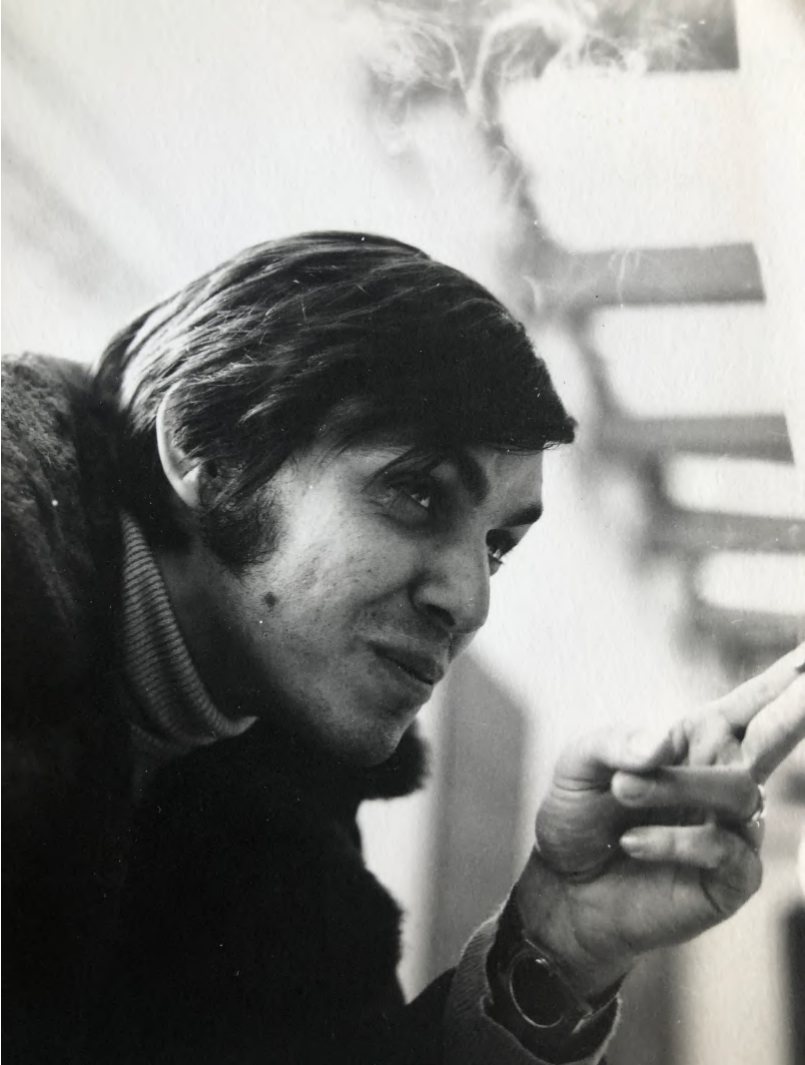
Born in 1946. Although his identity card says Adana, he is, in his own words, a native of İskenderun; he attended primary and secondary school in İskenderun, İstanbul and Mersin. His father painted and his elder brother was an art teacher; he came to know the smell of paint and turpentine at the age of five.
After the Gazi Institute of Education he was appointed to the İvriz Teacher Training School, where his encounter with the Central Anatolian steppe marked the beginning of his abstractions of nature. In Kassel, where he went on a state scholarship in 1971, he was shaken by documenta 5 and transformed his lyrical abstraction into an expressionist, conceptual abstraction.
Back in Ankara in 1977, he brought air pollution, migration and unplanned urban growth onto the canvas through colour scales, collage and screenprinting. He taught art for forty-five years at Gazi, Hacettepe and Yeditepe universities; since 1997 he has lived and worked in İstanbul.
solo exhibitions
awards
45years of teaching art
Academic background
Undergraduate
Gazi Institute of Education, Painting · 1966
Postgraduate
Kassel State Academy of Fine Arts · 1976
Doctorate
Mimar Sinan University · 1983
Courses taught
Undergraduate
Elective Painting, Painting III, Painting IV, Painting V
Postgraduate
Seminar, Diploma Project, Thesis
Proficiency in Art (doctoral level)
Painting I, Painting II, Seminar, Thesis
Research interests
World painting, contemporary art, Turkish painting and contemporary Turkish painting.
A painter’s life, full of hardships and achievements
Written by his daughter Burçak Gönül as a biographical novel, Yel Değirmenlerine Karşı – Bir Ressamın Anıları (Against the Windmills – A Painter’s Memoirs) is the most comprehensive source on the artist’s life. From Hatay to the steppe of İvriz, from Kassel to Ankara and İstanbul: the story of a family and of an artistic journey.